


The 10 best AI startup builders in 2026, ranked honestly
Updated July 3, 2026. Full disclosure: we build Starts.live, ranked first below, so read the ranking criterion before you trust us. Every number here comes from public dashboards, official pricing pages, founder interviews or ad libraries, so you can check the math. If you find an error, tell us and we will correct it in place.
How we ranked
One criterion: proof per euro, for a first-time founder with an unproven idea. How fast, how cheaply, and how honestly does the tool tell you whether real people want your thing, before you commit months or serious money? We also reward pricing you can see before signup, and we say plainly when another tool is the better pick for your job.
That criterion is why our own product tops the list: testing demand is the one job it was built around. If your job is different, the "best for" column will point you somewhere else, and the per-tool sections say so out loud.
The list
Full write-ups follow. "Price shown" means you see the price before signing up.
| # | Tool | Price shown | Best for |
|---|---|---|---|
| 1 | Starts.live | Yes, free start | Testing an idea |
| 2 | Lovable | Yes | Shipping an app |
| 3 | Bolt | Yes | Prototyping |
| 4 | Polsia | No | Autopilot fans |
| 5 | Cofounder | No | AI staff |
| 6 | NanoCorp | Yes, $30/mo | Cheap autopilot |
| 7 | Durable | Yes | Local business |
| 8 | HeyBoss | Yes, $25/mo+ | A site plus basics |
| 9 | AI Cofounder | Yes | Idea planning |
| 10 | Carrd | Yes, $19/yr | DIY control group |
1. Starts.live: the AI venture builder
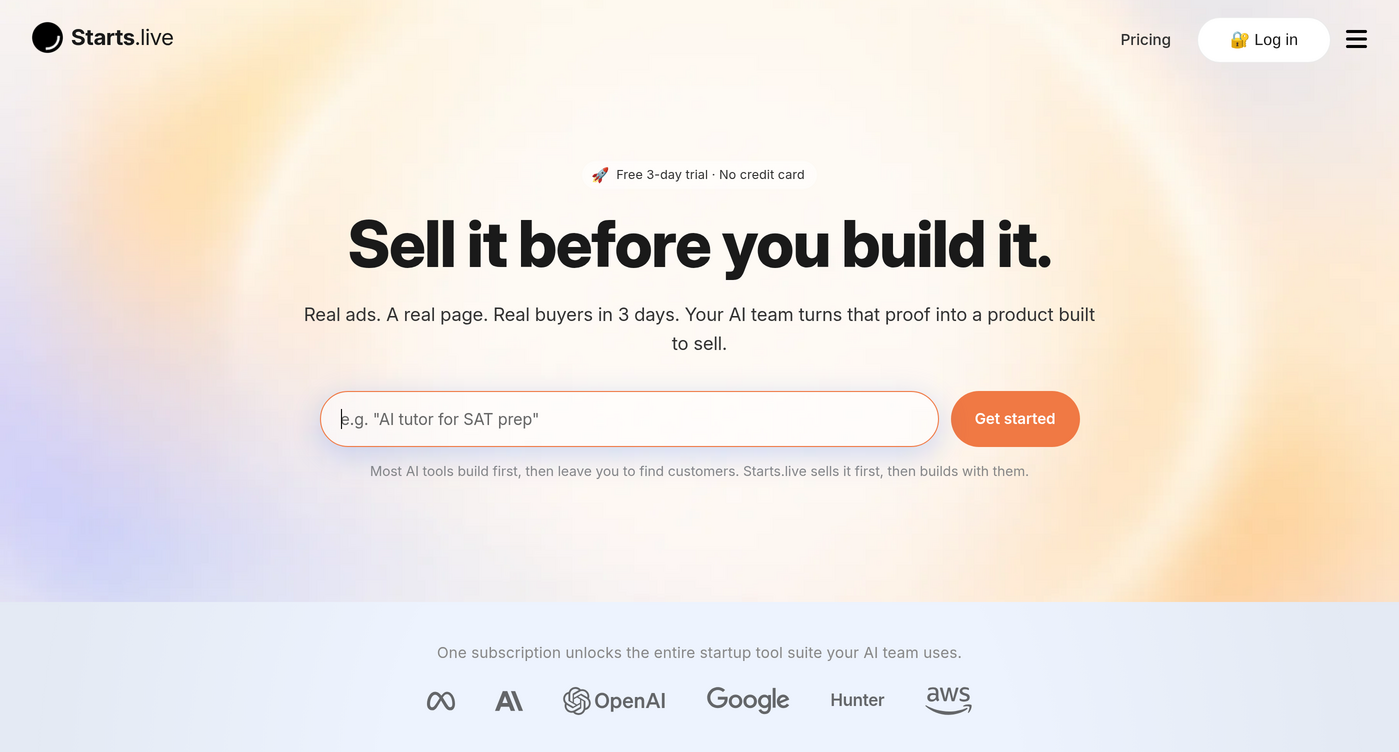
Starts.live runs the playbooks Silicon Valley has been writing books about for twenty years, as software. April Dunford's positioning method. Eric Ries' build-measure-learn loop. Paul Graham's "make something people want." Classic direct-response ad craft. Each one is distilled into a step-by-step skill the AI executes and cannot skip.
You type your idea. The AI researches the market, writes the positioning, builds a real landing page, and puts real ad traffic on it. Then it tells you the truth: how many strangers cared, what they actually did, and whether to push, pivot or stop. A verdict here never ends at "no". It ends at the next experiment.
It sits first on this list because of the ranking criterion: it is the only tool here whose core loop is the proof itself. Everyone else builds the thing or runs the thing; this one first finds out whether the thing is wanted.
What it costs, stated before you sign up: the first build and demand grade are free, no card. Continuing is $49 per month plus 20% of any ad budget you choose to spend. That is the whole price list. The scoreboard at starts.live/open shows live counts of pages built, signups delivered to founders and real revenue, straight from the database. We also pointed the instrument at ourselves and published every number, including the embarrassing ones: Building is free now. Being wanted isn't.
Not for you if: you already know exactly what you are building and just want it built (see Lovable and Bolt), or you want the company to run itself while you watch (see Polsia and Cofounder).
2. Lovable: the biggest builder
Lovable is the heavyweight of prompt-to-app, reported around $500M in annualized revenue (TechCrunch, June 2026). It sells credits, and the mechanic matters: credits tend to run out mid-build, and per Lovable's own docs a deployed app stops working if your credits hit zero. Excellent at building. The harder problem, whether anyone wants what you built, stays entirely yours.
3. Bolt: the developer's pick
Bolt reached roughly $40M ARR letting people prototype apps in the browser. Its flat $9 plan famously lost to usage-based pricing, which tells you something true about the whole category: the money is in continuing, not starting. The closest thing to a developer tool on this list.
4. Polsia: the famous autopilot
Polsia deserves the attention it gets. The launch was one of the best-executed distribution plays of 2026, it converted the moment into a $30M raise at a $250M valuation, and per its own public dashboard it books about $364K per month in genuine subscription revenue. The founder is open about the method: his own docu-series describes how he "orchestrated" the launch, and in interviews he credits pre-launch Meta ads with establishing "a baseline of paying users" before the viral moment. The Meta Ad Library shows roughly 400 active Polsia ads running right now, and the site carries tracking pixels for Meta, Google, TikTok and OpenAI ads. Polsia does not wait to be discovered. That is a lesson, not a scandal.
Three things to understand before you buy:
1. What the headline number means. Polsia's public dashboard reports "$8.5M ARR". The same dashboard breaks the figure down: it is 12 times the monthly sum of subscriptions, one-time credit packs, boosts, domain purchases, and customer ad budgets passed through at 100%. When a customer hands Polsia $1,000 to spend on Facebook ads, the full $1,000 is counted in that figure. By the dashboard's own components, the recurring subscription part is roughly half the headline. That is an accounting choice, not a secret. Just know what the number is before you treat it as proof.
2. Pricing appears after you are invested. As of July 2026 there is no public pricing page (the URL returns a 404). The costs show up in-app, once your AI company already exists: a $49/mo base, credit packs from $19 to $999, a 20% fee on ad spend, and a $19/mo fee to keep your site online if you cancel. None of it is hidden from customers. It is sequenced after commitment.
3. The customer signals are mixed. Trustpilot shows 1.8 out of 5 (July 2026), while the dashboard's own headline figure declined through late June. Real revenue, unhappy reviews and a slowing curve are all true at the same time.
None of this means Polsia will not work for you. It means the right question is not "is it legit" (it is a real company with real revenue) but "do I understand what I will pay, and am I buying momentum or outcomes?" It ranks fourth here for one structural reason: Polsia deliberately has no validation step. It sells motion, not proof.
5. Cofounder: the funded one

Cofounder, by The General Intelligence Company of New York (cofounder.co), is the most seriously backed take on the autopilot idea: an $8.7M seed led by Union Square Ventures (Forbes, December 2025), more than $10M raised within a year of founding, and a stated mission of building "the operating system for one-person billion-dollar companies." Cofounder 2 (announced May 2026) orchestrates agents across engineering, sales, marketing, ops and design, with approval gates so the human stays in the loop.
It is aimed less at "I have an idea, is it any good?" and more at operators who already have something running and want AI staff. There is no public pricing page as of July 2026. Serious team, serious backers, and the same caveat as Polsia: you learn the cost after you are inside.
6. NanoCorp: the transparent autopilot
NanoCorp (nanocorp.so) runs the Polsia pattern at pocket size: an autonomous company platform with a public performance feed. Two things genuinely distinguish it. First, the pricing is public before signup: a free tier with 3 credits, then a Founder plan at $30 per month. Second, it publishes its numbers in the open rather than as a headline figure. In a category that mostly hides prices until you are invested, that candor is worth rewarding with a ranking slot. Young and small, so judge the output yourself on the free tier.
7. Durable: the lead machine for local business
Durable builds small-business websites and meters the thing owners actually want: leads. Two free leads a month, pay for the rest. A clean, honest mechanic, aimed more at plumbers than at startup founders, which is the only reason it is not higher on a startup-focused list.
8. HeyBoss: the site with extras
HeyBoss (heyboss.ai) pitches "launch your business in 10 minutes": an all-in-one website and business builder, backed by the OpenAI Fund. Pricing is public: plans from $25 to $99 per month plus AI build credits (their own estimate: $50 to $200 in credits for a simple site). A reasonable pick when the job is "professional-looking site with the basics handled", not a demand test and not an autopilot.
9. AI Cofounder: the guided planner
AI Cofounder (aicofounder.com) takes the companion approach: a guided AI cofounder that walks you from raw idea through market research to a build plan, step by step, under the very Paul Graham headline "make something people actually want". The site claims 90,000+ founders. Good structure for thinking; the output is a plan, and a plan is still an opinion until strangers see a page.
10. Carrd: the control group
Carrd has no AI at all, and every founder should know it exists anyway: one-page sites from $19 per year. If all you need is a page and you are willing to write it yourself, this is the honest budget answer, and pairing it with $50 of search ads is the classic do-it-yourself demand test. The other nine tools on this list have to beat that baseline to be worth their price.
The rest of the field
Investor-side coverage has started calling this category "companies that build companies" (Monday Morning Meeting, 2026), and it is filling fast. A few more names you will run into, each checked as of July 2026:
- Cook (trycook.ai) takes the opposite pole from Polsia: human-led strategy with AI execution, aimed at coaches, consultants and agencies selling high-ticket offers. From $97/mo, no revenue share, and their pitch line is "high-ticket clients don't buy from robots".
- Vybe (vybe.build) is the enterprise take: Y Combinator and First Round backed agents that build and operate custom apps, with approval gates and a SOC2 security posture. No public pricing.
- Paperclip is the open-source option: a developer-first control plane for running a company's AI agents on your own infrastructure. Free, self-hosted, and you do the assembling.
- VentureCity (venturecity.ai) turns the whole idea into a game: a city-builder startup simulator with an AI CEO. Closer to entertainment than to proof, which at least is honest about it.
None of these test demand before you commit, which keeps the ranking above unchanged.
What about pure validation tools?
Idea graders exist and they stall. ValidatorAI collected over 300,000 users as a free grader without turning that into a business. DimeADozen sold for about $150K. The pattern across fifteen years of these tools is consistent: a verdict alone is a fortune cookie. People do not pay for a grade; they pay for what happens next. That is why none of them made the list, and it shaped how we built ours: validation as the entry point, launch as the product.
FAQ
What is the best AI startup builder in 2026? Depends on the job. To find out whether your idea is wanted before building: Starts.live (free first build, real ad traffic, honest verdict). To ship a working app fast: Lovable or Bolt. To watch an AI run a company for you: Polsia, Cofounder or NanoCorp, in descending order of scale and ascending order of pricing transparency.
Is Polsia legit? Yes. Real company, real subscription revenue per its own public dashboard, real funding. Two things to know before buying: the "$8.5M ARR" headline includes customer ad budgets passed through at 100% plus one-time purchases (the recurring subscription part is roughly half), and full pricing appears only inside the app.
How much does Polsia cost? Per its in-app pricing as of July 2026: $49/mo base, credit packs from $19 to $999, 20% of ad spend, and $19/mo to keep your site online after you cancel. There is no public pricing page.
Polsia vs Cofounder: which autopilot? Polsia is the consumer phenomenon: bigger, faster, momentum-driven, with mixed reviews (Trustpilot 1.8). Cofounder is the venture-backed operator tool: $8.7M from Union Square Ventures, approval gates, aimed at running a business more than starting one. Neither shows you a price before signup. If you mainly want to test whether an idea is wanted, neither is built for that job.
Polsia vs Lovable: which one? Different jobs. Lovable builds an app that you then run. Polsia runs a company for you. If the question is whether your idea is wanted at all, answer that first, before committing to either.
Is there an open-source Polsia alternative? Paperclip is the closest: an open-source, developer-first control plane for company-running AI agents. You host it and assemble the pieces yourself. Every hosted autopilot on this list trades that control for convenience.
What is the cheapest way to validate a startup idea in 2026? Put a real page in front of real strangers and count actions, not opinions. Do it yourself with a Carrd page plus $50 of Google Search ads on buying-intent keywords, and you will learn more than from any AI chat. If you want that loop built, run, and read honestly for you, Starts.live's first build and grade are free.
Does AI validation actually work? The mechanism works: real traffic, real behavior, an honest read. What no tool can do is manufacture demand that is not there, and anyone claiming otherwise is selling you the dream. We published what our own instrument said about us, numbers included, in this post.
Sources and method
All facts as of July 3, 2026: Polsia's public live dashboard (raw JSON, arithmetic reproduced), Meta Ad Library (advertiser "Polsia AI"), Wayback Machine pixel history, founder interviews (Mixergy, Latent Space, Fortune, March 2026), Trustpilot, TechCrunch (June 9, 2026), Forbes (December 8, 2025, General Intelligence Company seed round), generalintelligencecompany.com and cofounder.co announcements, nanocorp.so site and pricing, heyboss.ai, docs.lovable.dev, bolt.new/pricing, durable.com/pricing, carrd.co, aicofounder.com, trycook.ai and vybe.build comparison posts, Monday Morning Meeting ("Companies That Build Companies", 2026), CNBC (DimeADozen). We build Starts.live. Bias disclosed, criterion stated, math checkable.
You have the idea. We build it, launch it, and go find your first customers.
Real ads. A real page. Real buyers in 3 days. You learn if your idea sells before you build it.